Key Considerations for Installing Rainbow Slides Across Different Terrains
As a non-motorized amusement attraction, the core of installing a rainbow slide lies in controlling the gradient, ensuring a solid foundation, and perfecting the drainage system. Construction standards vary significantly depending on the terrain, directly impacting the project's safety and service life. The optimal gradient for these slides is generally between 9° and 15°, with an absolute maximum of 20°. Additionally, a buffer zone comprising no less than 30% of the slide's total length must be reserved at the end to prevent runaway speeds and ensure safe deceleration.
Natural Hillsides
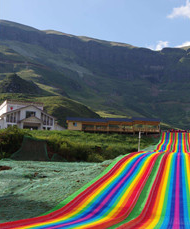
Natural slopes are the most common sites for these installations. Before construction, the slope must be cleared of loose rocks, floating soil, and debris, and any uneven ground must be leveled. Soil-based slopes require compaction and reinforcement, while rocky surfaces need to have sharp protrusions ground down. It is mandatory to excavate drainage ditches on both sides for effective cross-drainage, preventing water accumulation from eroding the foundation. The slide must be secured using ground anchors and expansion bolts, and the site must be thoroughly inspected for potential hazards like falling rocks or landslides.
Flat Ground & Plazas
Since flat areas and plazas lack a natural gradient, an artificial slope must be constructed using either earthwork embankments or elevated steel frameworks. For earthwork embankments, the soil must be compacted in layers and topped with a concrete base pad. Steel framework construction requires anti-corrosion treatment and must be secured via anchoring or concrete foundation piers to guarantee structural stability against overturning. For grasslands or soft soil with poor bearing capacity, panels must never be laid directly on the ground. Instead, a gravel base pad for reinforcement or an elevated steel framework is required to prevent future settlement and collapse.
Depressions & Waterfront Areas
For damp environments like depressions or areas near water, the slide's foundation must be elevated. Ring drainage ditches and blind ditches (subsurface drains) should be added, and all metal components must undergo thorough anti-corrosion and rust-proof treatment.
Universal Installation Standards
Regardless of the terrain, it is essential to ensure that panel joints are perfectly flat and free from warping, with safety guardrails fully installed on both sides. Upon completion, the slide must undergo dual testing under both dry and wet conditions to guarantee safe operation before opening to the public.