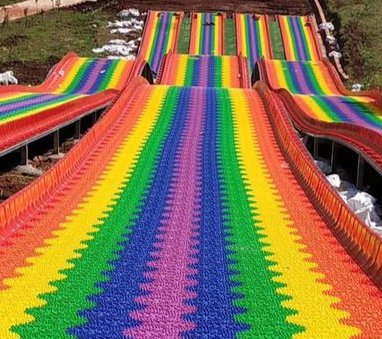
Optimal Gradient Standards for Rainbow Slides: A Technical Guide for International Buyers
As a popular non-powered amusement attraction, the scientific design of the slope for a rainbow slide is fundamental to ensuring both safety and rider experience. A steeper slope does not necessarily mean more excitement; rather, a precise balance must be struck between gravitational acceleration and frictional resistance.
Generally, the optimal slope for a rainbow slide ranges from 13° to 30°. For straight sections, a slope of 18° to 25° is recommended, as it ensures a safe sliding speed of 2 to 6 meters per second while providing a sufficient sense of weightlessness. For S-shaped curves, the slope should be controlled between 15° and 20° to mitigate the risk of rollover caused by centrifugal force.
Beyond the angle, the ratio between slope and length is equally critical. The slope length should be at least 6 to 7 times the vertical drop to ensure a smooth transition and prevent abrupt braking at the end. For natural terrain, contour mapping is required to ensure the slope surface flatness error is ≤5cm. For flat ground, a steel frame structure must be erected with column spacing of 2 to 3 meters and a foundation bearing capacity of no less than 150 kPa. Furthermore, slope design should be adjusted according to the target audience: children's slides should use the lower end of the range with increased surface friction, while adult slides can have a steeper slope for enhanced excitement. Only through scientific slope planning can a rainbow slide truly become a popular destination that combines safety with joy.