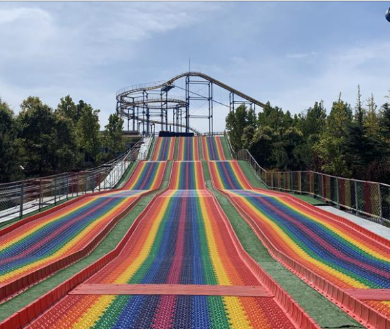
How does the lubrication of a rainbow slide compare to real snow?
Under normal temperatures, the surface lubrication of a rainbow slide can reach 90% of real snow. This means that, under ideal conditions, a dry-ski track can replicate most of the gliding experience you'd get on real snow.
The secret to this high level of realism lies in its materials and design. Rainbow slides are typically made from High-Density Polyethylene (HDPE), a material known for its self-lubricating properties. Through precision molding, the surface roughness is strictly controlled to maintain a stable sliding speed. The physics behind it is simple: it relies on minimizing friction on a slope to allow for a fast, smooth descent. Because of this, the feel is incredibly close to real snow, and skiers can even perform advanced techniques like edge carving and turning.
However, that 90% figure isn't an absolute guarantee. As a gravity-powered (unpowered) descent sport, the actual speed of a rainbow slide is highly sensitive to humidity and temperature. For instance, it gets noticeably faster in rainy or cold conditions, while sunny days might slow it down—the speed difference can easily exceed 20%. Also, since dry snow has slightly more friction than real snow, the speed is a bit lower, and the margin for error is smaller. So, first-timers might need a little time to get used to it.
In short, while the lubrication technology of rainbow slides has achieved a highly realistic simulation of real snow, it serves as a "time-and-space extension" alternative. It brings year-round sliding fun while still keeping its own unique physical characteristics and riding feel.