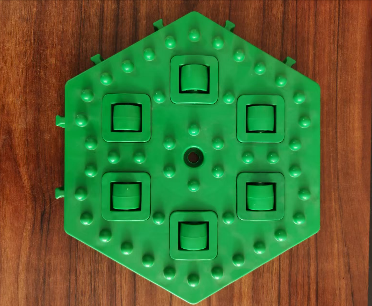
Rainbow Slide Blocks Guide: Types, Functions, and Applications
Rainbow slides have become a highly popular outdoor non-powered amusement equipment. Known for their vibrant colors and smooth gliding experience, they are widely used in scenic spots, amusement parks, farms, and other family-friendly or trendy recreational settings. The overall gliding effect, stability, and safety of a rainbow slide largely depend on the material, structure, and types of the sliding blocks. In the market, rainbow slide blocks are mainly categorized by their shape, fastening methods, and functional purposes, each serving specific roles to accommodate different slopes and site requirements.
The hexagonal block is the most mainstream and widely used basic style, available in both single-lock and double-lock versions. Single-lock hexagonal blocks feature a simple structure, are easy to assemble and disassemble, offer moderate load-bearing capacity, and are highly cost-effective. They are generally used in small to medium-sized leisure rainbow slides, making them ideal for daily family entertainment. Double-lock hexagonal blocks provide tighter joints and stronger stability. They are highly wear-resistant, compression-proof, and less prone to loosening or displacement, effectively enhancing gliding safety. These are commonly used in high-standard rainbow slides with longer distances and steeper slopes.
Rectangular blocks are also common complementary options, similarly available in single-lock and double-lock structures. Double-lock rectangular blocks feature a smooth surface and extremely tight seams, ensuring a seamless, stutter-free glide with excellent stability. They are perfect for multi-person racing slides, meeting the demands of simultaneous use. Single-lock rectangular blocks are lightweight and flexible, primarily used for edge protection, finishing connections, and structural alignment to provide safety transitions and maintain the overall neatness of the slide.
In addition, there are specialized hexagonal deceleration blocks. Designed with a moderate coefficient of friction, these blocks are typically installed in the middle to lower sections of the slide to provide a buffering and braking effect. This prevents excessive speed and potential safety hazards, making them ideal for professional rainbow slides with steep gradients and long distances. A well-matched combination of different block types ensures that the rainbow slide is safer, more durable, and smoother, ultimately delivering a comfortable and stable riding experience for visitors.