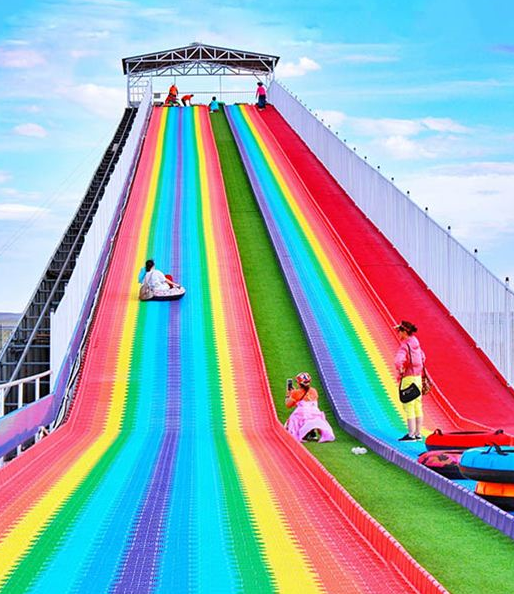
Rainbow Slide Gradient Selection: A Comprehensive Analysis from Site Conditions to Safety Standards
The required gradient for rainbow slides isn't a fixed value; rather, it's selected from a flexible range based on site conditions, slide type, and safety standards. Based on industry insights, the typical gradient falls between 10° and 25°:
Minimum Requirement: The slope should generally not be less than 5°, as anything shallower results in sluggish speeds and a poor user experience. However, some basic models can operate on gentle slopes of 5°–7°.
Optimal Range: To strike the perfect balance between speed and safety, most manufacturers recommend a gradient of 15°–20°.
Common Range: Many slides are designed with slopes between 15° and 30°, with 18°–25° being another widely adopted specification.
Utilizing Natural Terrain: The ideal site features a natural hillside or slope of 10°–25°. This allows for direct installation with minimal earthwork and lower construction costs.
Artificial Slopes: For flat sites or areas lacking sufficient natural gradient, artificial slopes can be constructed using steel frames or scaffolding. This offers design flexibility; for instance, some projects feature an average gradient of 28°.
Specialized Slides: Certain track-based grass skiing projects require less gradient, operating effectively on natural slopes of just 5°–7°.
Key Design Considerations:
Gradient vs. Speed: Slope is the primary factor controlling sliding speed. Professional designs cap the maximum speed at 40 km/h to ensure rider safety.
Gradient vs. Length: Slide lengths typically range from 30 to 300 meters. The gradient and length must be carefully balanced to guarantee an adequate ride duration and a satisfying experience.
Safety Buffer: A horizontal buffer zone of at least 5 meters, equipped with cushioning mats, is mandatory at the end of the slide.
In summary, while there is some flexibility in gradient design, the 10°–25° range is the most universally recommended for ensuring both safety and enjoyment. Ultimately, the final design should be determined by a professional team through on-site surveying and engineering calculations.