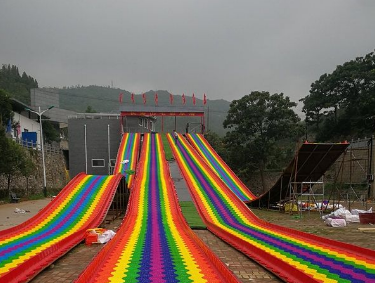
Key Differences in Building Rainbow Slides in Mountainous vs. Flat Terrains
As a popular outdoor attraction, rainbow slides differ significantly depending on whether they are built in mountainous or flat terrains. These differences mainly come down to construction methods, costs, guest experience, and long-term maintenance. Each terrain type has its own advantages and suits different operational needs.
Construction Costs and Land Utilization
Mountain slides take advantage of natural slopes, which means you don't need massive steel frameworks. By simply leveling the slope and ensuring proper drainage and reinforcement, you can significantly cut down on construction materials, costs, and build time. However, mountains require careful handling of slope stability and rainwater runoff, which can make the initial site survey more expensive.
Flat terrains, on the other hand, lack natural elevation. You have to build the slope and起伏 (undulations) artificially using soil mounds or steel structures. This requires more materials and complex construction, leading to higher overall costs. The big advantage here is flexibility—you aren't limited by natural topography.
Riding Experience and Scenery
The riding experience and visual appeal vary greatly. Mountain slides use the natural terrain to create long, undulating routes with smooth, natural drops. This gives riders a rich variety of speeds and a highly immersive experience surrounded by forests and valleys.
Flat slides rely on custom-built, artificial slopes. The ride is smoother and more consistent, making it safer and perfect for families with young children. However, the scenery is more uniform and lacks that natural, outdoor atmosphere.
Maintenance and Operations
Mountain slides face challenges like landslides, falling leaves, and water pooling. They require regular safety inspections of the slopes and frequent clearing of debris, making maintenance a bit more demanding.
Flat slides have a neat, open layout. Daily cleaning and equipment checks are much easier, wear and tear is lower, and the structure is highly stable. This makes them ideal for city parks or suburban plazas that need consistent, everyday operation.