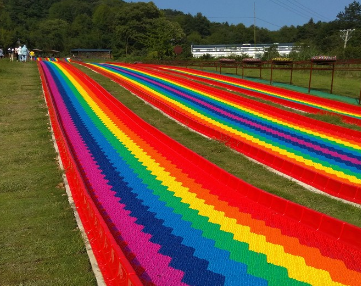
Foundation Fixation and Reinforcement for Rainbow Slides
Rainbow slides are high-frequency unpowered amusement facilities. The foundation fixation and reinforcement are directly related to visitor safety and the long-term operation of the project. A rational reinforcement plan should be formulated based on site conditions, with three practical methods primarily available:
1. Reinforced Concrete Foundation Reinforcement: Suitable for long-term installations. For flat terrains or soft soils with poor bearing capacity, the foundation trench must be excavated first, followed by replacing the soil with graded crushed stone or reinforcing the soil layer using cement-soil mixing piles, and then pouring the reinforced concrete. During construction, steel embedded parts (with a thickness of at least 20mm) and anchor rebars must be precisely embedded to ensure the strength of the core load-bearing components, providing a stable foundation support for the slide.
2. Steel Structure Bracket Reinforcement: Commonly used for mountainous terrains with significant elevation drops. Q235B grade H-beams and other profiles are precisely cut and assembled into column and beam frameworks using high-strength bolts or welding. After welding, the components undergo stress-relief treatment to prevent deformation and are subjected to quality testing. The base of the brackets is secured to the concrete foundation with expansion bolts to enhance the overall structure's wind and compression resistance.
3. Panel and Buffer Zone Anchoring: The HDPE panels of the slide must be fixed using stainless steel ground nails or expansion bolts at a standard spacing of approximately 1.5 meters. Cross-anchoring with wind ropes can also be applied to enhance wind resistance. For the buffer zone at the end of the slide, high-density EVA pads and artificial turf must be laid, ensuring a sufficient deceleration distance to guarantee safety during the sliding process.