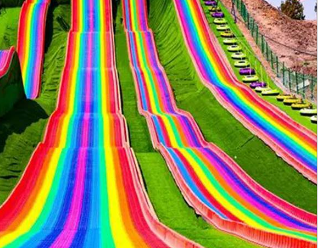
Construction Solutions for Rainbow Slides on Natural Soil Slopes
When building a rainbow slide on a natural soil slope, you don't need massive earthworks to shape the terrain. This makes construction convenient and cost-effective. Currently, there are three mainstream construction methods, tailored to different site conditions, budgets, and operational needs:
1. Compacted Soil with Direct Paving
This is a low-cost, simplified construction method. First, the slope's gradient is graded and debris is cleared. A roller is then used to compact the slope in layers, ensuring a flat and dense base without the need for concrete hardening. After compaction, a cushioning layer is laid, followed by the interlocking and securing of the rainbow slide panels and the installation of protective guardrails. This method features a short construction cycle and low costs, making it ideal for temporary operations, rural parks, and sites with limited budgets. However, it has weaker resistance to rain erosion and requires regular slope maintenance.
2. Slope Hardening with Paving
This is the standard, mainstream process for scenic areas. After the soil slope is graded and compacted, a concrete or cement mortar layer is poured over the entire surface to thoroughly reinforce the base and prevent any settlement or deformation. Once the hardened layer is fully cured, the slide modules are installed according to standard specifications, with the joints properly sealed. This method offers high stability, a long service life, and excellent slip and wear resistance, making it perfect for official scenic spots with long-term, high-frequency operations. The only downside is the relatively higher infrastructure costs.
3. Steel Frame Reinforcement
This method is designed for soil slopes with uneven gradients or loose soil. After a basic grading of the uneven terrain, a lightweight steel frame is erected to level the surface before the slide panels are secured. This approach not only corrects topographical defects but also avoids large-scale earthworks, striking a great balance between stability and cost-effectiveness. It is highly suitable for natural soil slopes with complex terrain where comprehensive hardening is not feasible.